Showing posts with label Standard of Living. Show all posts

Tuesday, January 21, 2020

Chile, Is Income Inequality a Problem?


Income inequality has been a hot topic for some time and it is a driving factor in the desire for economic policy reform across the globe. An uneven distribution of income seems to justify a top down solution if it redistributes unfair allocations of wealth. This, however, is not a clever strategy as the focus should instead be on what type of economic policies increase the well-being and individual freedoms of all, not just the elite. Increasing economic freedom and encouraging laissez-faire market policies are the only ways to lift the poorest among us from abject poverty and enjoy a significantly better quality of life relative to those who suffer from the plagues of planned economies.

Economic Freedom

Economic freedom, which is measured globally by both the Fraser Institute and Heritage Foundation, shows how free private individuals and businesses are in a country's economy. The Fraser Institute determines economic freedom based on 5 factors; size of government, legal systems and property rights, sound money, freedom to trade internationally, and regulation. To put things into context, Hong Kong is 1st, the United States is 5th, and Venezuela is the least free country measured. While this data is important, what actually matters is how economic freedom translates to a better life for those who enjoy it.

First and foremost, unhampered markets allow for resources to meet the needs of consumers in a very personal way. The Fraser Institute describes the cornerstones of economic freedom as
“...personal choice, voluntary exchange, open markets, and clearly defined and enforced property rights. Individuals are economically free when they are permitted to choose for themselves and engage in voluntary transactions as long as they do not harm the person or property of others. When economic freedom is present, the choices of individuals will decide what and how goods and services are produced.”

Imagining an economic system in which the consumer is king should entice and excite us. You and I decide which producers will flourish and which entrepreneurs will become household names based on their merits, not their noble lineage or some other arbitrary designation of power. With our consumption preferences everybody has the freedom to pursue their own ends by whatever purposive action they see most fit.


Economic Freedom and Income Inequality

Economic freedom and income inequality do not have a clear relationship. Research by Bergh and Nilsson (2010) found that 80 countries from 1970-2005 who experienced increasing economic freedom also realized a higher level of income inequality. Is this an unfair byproduct of capitalism or is it an illustration of consumers rewarding producers who meet their needs the best? While it appears to be the latter, many are still blind to this fact and ultimately disregard that each consumer was made better off through voluntary transactions. Wealth is not a zero-sum game and the rich don’t get rich by taking from the poor, instead they create more wealth and value for society as a whole.

Chilean Social Unrest

One important consequence of income inequality is the social unrest it has been known to cause, particularly of late in South America. Chile offers an opportunity to examine the impact of economic freedom on income inequality. The country has been devastated by riots and protests that have been occurring since October 18, 2019 in response to a multitude of social injustices. While Chileans may have every right to be upset, demanding immature economic policy is sure to exacerbate the problems. Political scandal and corruption is rampant all throughout South America indicating many of these problems are not unique to Chile, but what was special about Chile is the last four decades of pro market policy.

Allowing the market to operate with minimal government intervention has helped them become one of the freest and wealthiest countries in South America, especially when compared to their direct neighbors. Chile has significantly higher average wages measured in $USD (adjusted for Purchasing Power Parity). Chile's closest neighbor's wages are almost 44% lower than domestic levels, and Chilean wages will only continue to grow if capital continues to accumulate and human capital is allowed to develop further.

Another phenomenon that both protesters and media appear to ignore is the historic decrease in income inequality that has occurred in the same time frame discussed above. This is illustrated by the country’s GINI coefficient, a statistical measure of the distribution of wealth in a country, where a 0 is completely equal distribution and 1 (100) would be all the wealth residing with one person. In 1990 Chile’s GINI was 57.20 compared to 46.6 in 2017.
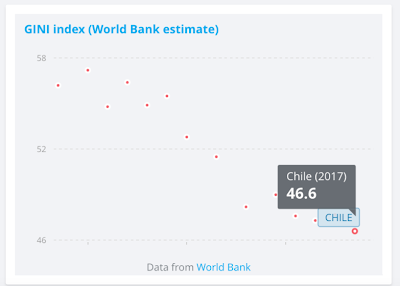
 

Whether this reduction in income inequality was the direct result of economic freedom is difficult to determine. More equal distribution can also occur through coercive policies such as high marginal tax rates, yet this damages the country’s overall long-term wealth. Instead, if that money were to be reinvested or saved, capital accumulation would generate positive spillovers for the poorest of citizens. Over time this creates downward pressure on prices as businesses are able to operate with more efficient tools and the population increasingly develops human capital, creating a more productive workforce. While in some cases economic freedom may lower income inequality, in others it may increase it, but that is acceptable as long as everybody (including the bottom 10%) can enjoy the benefits of a wealthier society.

While the GINI coefficient and average wages may indicate that the median conditions are better than neighboring countries, these measurements tell us nothing about those who are worse off. World Bank estimates that Chile’s poorest 10% of the population has 1.9% share of the country's income, higher than all border countries. Even though Chile does not have the largest GDP in the region, the poorest Chileans still have higher incomes than their immediate counterparts.

Country
Total GDP in $USD
Bottom 10% Share of GDP
Bottom 10% Share of GDP  in $USD
10% Of Total Population
Average Individual Share of Income For Poorest 10% Of Country
Chile
$277,746,000,000.00
1.90%
$5,277,174,000.00
1,847,043.90
$2,857.09
Argentina
$624,696,000,000.00
1.80%
$11,244,528,000.00
4,404,481.10
$2,552.97
Peru
$211,007,000,000.00
1.20%
$3,587,119,000.00
3,144,429.70
$1,140.79
Bolivia
$37,509,000,000.00
1.7%
$450,108,000.00
1,119,285.40
$402.14

*All Figures from 2017

https://data.worldbank.org/indicator/SI.DST.FRST.10?locations=CL-AR-PE-BO&name_desc=false
https://data.worldbank.org/?locations=CL-AR-PE-BO


In short, protesters have every right to bring to light atrocities committed by their government. It is wrong, however, to assume that the same government, or any other mix of bureaucrats, can deliver financial freedom through interventionist policy and coercive action. Instead, the focus should be on empowering individuals to pursue their own ends through free exercise in the market. Admittedly this could distort the distribution of income but at the expense of no individual --voluntary exchange is not a zero-sum game. Granting consumers the power to reward the producers who best serve their interests allows for concentration of income, but everybody, regardless of their share of that income, is made better off.
"Only because inequality of wealth is possible in our social order, only because it stimulates everyone to produce as much as he can and at the lowest cost, does mankind today have at its disposal the total annual wealth now available for consumption. Were this incentive to be destroyed, productivity would be so greatly reduced that the portion that an equal distribution would allot to each individual would be far less than what even the poorest receives today.”- Ludwig von Mises, Liberalism, 1927.

Jacob C. Maichel is a Graduate Assistant at the Gwartney Institute and an MBA student at Ottawa University

Bergh, Andreas, and Therese Nilsson. 2010. “Do Liberations and Globalization Increase Income Inequality?” European Journal of Political Economy, 26(4):488-505.

Friday, November 15, 2019

Why Capital Accumulation is Key to Raising Wages

By Jacob C. Maichel
"There are no other means by which the general standard of living can be raised other than by accelerating the increase of capital as compared with population" -Ludwig von Mises

It is clear that arbitrary minimum wage laws are not only ineffective, but actually detrimental to real wage growth. So what type of action results in increasing wages in the United States, or any country for that matter? The only way to raise real wages is to increase the per head quota of capital invested by increasing capital accumulation. To accomplish this it is first important to understand what is meant by capital accumulation.

Capital accumulation, as explained by Austrian Economist Ludwig von Mises, is wealth that is created and owned by businesses and individuals. This wealth is both saved and reinvested to create further profit. The capital which is accumulated is encompassed in everything that businesses utilize from tools to finished goods, and everything in between. Both individuals and businesses create further profit by loaning out excess wealth (either through direct investment or holding money in traditional savings accounts). It is important to note this accumulation can only occur when more wealth is created and saved than that which is consumed.

With the understanding of how capital accumulation works we can now examine how it will increase real wages. It is critical in this discussion to break down the commonly held belief that wealth and the creation of wealth is zero-sum. It is fallacious to assume the wealthy getting richer makes the poor worse off. Instead this wealth creation makes everybody better off! The standard of living in the United Sates is higher than anywhere else in the world not because our politicians are superior to their foreign counterparts, but instead because of the high per head quota of capital that is invested. This high level of investment has allowed businesses to use the most efficient tools available through capital investments, and this is why United States workers are so productive. Other countries do not lack the intelligence to grow but suffer from inadequate capital needed to drive higher efficiencies which lead to increasing production yields. As the accumulation of capital becomes larger wages will raise as businesses compete for the most skilled workers. Only through the free market can wages increase for everyone, rather than the lucky few who benefit from minimum wage laws. 

The best way for government to encourage capital accumulation is to leave the market alone. Manipulating interest rates and the money supply through the federal funds rate or monetary policy sends the wrong signals to businesses. As the interest rate artificially drops and encourages borrowing individuals will save less and business will take on projects they would have not pursued otherwise. These malinvestments, as Mises calls them, are the direct cause of government intervention and detrimental to the accumulation of capital. Examples of malinvestment are present all over the world, from the United States housing bubble to unfinished sky scrapers such as the Nakheel Tower in Dubai. 

Another strong way to encourage capital accumulation is through lowering tax rates, particularly for corporations and wealthy individuals. Although this may be counter-intuitive for some who think that it is the governments role to redistribute excess wealth to help the common man, this is not the case. In Planning for Freedom: Let the Market System Work Mises states the following:
"United States were in the last decades directed toward confiscating ever-increasing portions of the wealth and income of the higher brackets. The greater part of the funds thus collected would have been employed by the tax-payers for saving and additional capital accumulation. Their investment would have increased productivity per man-hour and would in this way have provided more goods for consumption. It would have raised the average standard of living of common man. If the government spends them for current expenditure, they are dissipated and capital accumulation is concomitantly slowed down."  
The tax payers or businesses are able to save and invest more if they are taxed less, or not at all. Although this does make them more wealthy, it does not make the common man more poor. Instead from a material perspective everybody prospers. By allowing wealth accumulation resources are enabled to flow into their most efficient use, dictated by consumer demand, instead of bureaucrats deciding how money is transferred. The following graphic from Tax Foundation is a perfect illustration of Mises' argument, lower taxes results in increased production and wages.
 Anti-growth policy and propaganda has been incredibly strong in attempting to destroy Austrian Economic ideals, particularly in the recent years. We are continually told that wealth is a bad thing when clearly that is not the case. The most effective way to increase production and the standard of living to promote wealth creation and saving by leaving the free market to it's own devices, unfettered by interventionist policy. A laissez-faire approach does not strictly favor the wealthy capitalist, but rather the interests of the common man.

Jacob C. Maichel is a Graduate Assistant at the Gwartney Institute and an MBA student at Ottawa University