Showing posts with label Austrian Economics. Show all posts

Thursday, December 3, 2020

Walter Williams's Students Explain What Made Him Such a Great Economics Teacher

Editorial note: We at the Foundation for Economic Education mourn the passing of Walter Williams, a great economics educator and a long-time friend of FEE who distributed our publications and cheered on our work. We are forever grateful to Dr. Williams for his heroic contributions to the cause of economic freedom and understanding.

Walter Williams, renowned economist—and my teacher—has passed away. He was 84. His accomplishments as a researcher, teacher, and public intellectual are too great to number in a single article, so I’ve decided to write about the side of Dr. Williams I was blessed to experience personally: Walter Williams the teacher.

“I think you’re right, but it’s kind of clumsy.”

Those were the first words Walter Williams said to me after my long-winded answer to a question about the paradox of value. Dr. Williams, like all great teachers, understood the most important thing in economics was getting the fundamentals right. Like the great UCLA Basketball coach John Wooden taught each of his players to tie their shoes, Dr. Williams had us tie our proverbial shoes every lecture in our PhD Microeconomic Theory class. Concepts and phrases like “production”, “utility”, and “consumption” we took for granted were often the target of refinement by our professor.

However, he never did so to tear us down. Rather, he pushed students to perform at the highest level he could by probing our knowledge with grace and humor. His examples were both relatable and funny.

Although there are too many examples to include, I’ve added testimonials by some of Dr. Williams’s students over the years about what they enjoyed about him as a teacher. But first, I’d like to offer one last anecdote of my own.

Dr. Williams once posed a puzzle to us which was originally posed by his teacher (the late, great Armen Alchian) for which he claimed to have no satisfactory answer. He asked, “why is it that present generations produce goods from which future generations many years ahead of them benefit? That is the people who built the Brooklyn bridge, they’re all dead, but current generations benefit from their sacrifices. Why’d they do that?”

Dr. Williams batted our answers down with relative ease. Although, to my knowledge, he never received a satisfactory answer, Dr. Williams has become a subject of his very own puzzle. I’m reminded by a poem by William Allen Dromgoole about an old man who, after crossing a large stream, took time to build a bridge behind him. When a fellow traveler asked him why he bothered to build a bridge after already passing, the old man responded:

This chasm, that has been naught to me,

To that fair-haired youth may a pitfall be.

He, too, must cross in the twilight dim;

Good friend, I am building this bridge for him.

Like the subject of his puzzle, and the old man in Dromgoole’s poem, Dr. Williams was a bridge-builder.

In the 40 years he served as professor at George Mason University, Dr. Williams imparted the fundamentals of economics in the property rights tradition of UCLA to his students. He could have gotten by with being less focused on teaching, as he had multiple streams of income, but instead he produced in the minds of his students an understanding of economics that will long outlast him and bless many a “fair-haired youth.” Despite the fact that my cohort was one of the last groups of students lucky enough to see him lecture, we will not be the last of his students. Dr. Williams’s influence will continue to operate in a generation of economics teachers which, like a sturdy bridge, will continue his legacy.

I would like to take one more stab at Dr. Williams’s puzzle: why do mortal beings, like he himself, create value that will outlast them? Dr. Williams once described love as when you receive utility because another person receives utility. So, although Dr. Williams would scorn my unfalsifiable preference-based explanation, I believe this is the reason why he worked so hard for his students. Dr. Williams loved his students and the science of economics, and that is why he bequeathed so much to us.

Finally, I’m only one student of Dr. Williams.

To make his own impact clearer, I’ve gathered testimonials from just a few of his many former students.

“Walter was a friend of FEE’s and a friend of mine as well—a one-of-a-kind friend. He never failed to return a phone call or respond to an email. He went the extra mile when we asked him for anything. And in his love for liberty and sound economics, he was solid as a rock. We will never forget his plainspokenness, his generosity, his candor. He leaves behind a lasting legacy to which we should all aspire.”

– Lawrence W. Reed, President Emeritus, Humphreys Family Senior Fellow and Ron Manners Global Ambassador for Liberty.

d12e9117613a1599144490-donate-thankyou-landscape.png

Join us in preserving the principles of economic freedom and individual liberty for the rising generation

“I had the honor and privilege to be a student in Professor Williams’s PhD Microeconomic Theory course. For 3 hours every Tuesday night during the Fall of 2013, I was completely ‘hooked’ by his clarity of thought, wittiness of presentation, and colorful anecdotes, all of which illustrated to me how a consistent and persistent application of the economic way of thinking can explain human action in all its manifestations. He has been a role model that I’ve strived to emulate as a teacher of economics.”

-Rosolino Candela, Associate Director of Academic and Student Programs, Mercatus Center

“Walter Williams was a first-rate economist. He was an inspiring and compassionate teacher, an accomplished scholar, and a master at communicating complex economic ideas to the public.”

-Christopher Coyne, Professor of Economics, George Mason University

“My favorite memory from Williams’s class comes from his lecture on producer theory. He asked the class why profit maximization required the marginal cost function to be increasing at an increasing rate. I eagerly raised my hand, Williams called on me, and I began explaining why this is was a necessary condition for profit maximization. After about 10 seconds, Williams interrupted me and said, ‘you were right, but then you kept talking,’ which got a laugh from everyone in the class, including me. This is how we was as a teacher: brilliant, clever, sharp, and demanding. I will miss him greatly.”

- Bryan Cutsinger, Assistant Professor of Economics, Angelo State University

"Dr. Williams gave his life to the teaching of economics, each day in class and until the end. Aside from his mastery of the principles, what stood out to me in his microeconomics class was the individual way he dealt with each student. Williams revealed his brilliant wit and mischievous sense of humor when dealing with more confident students, but with shy students like myself, he became gentle and almost grandfatherly. He was also the first person I told about my interest in studying the family from the economic perspective, and he took time to introduce me to some classic research and encourage me in my work.

His memory will live on in each of his many, many students as they seek to emulate his profound love for teaching and deep commitment to thinking properly."

-Clara Jace, PhD Fellow, George Mason University

“My fondest memory is when Professor Williams asked the question: ‘I know oleomargarine is a substitute for butter, but what else is a substitute for butter?’ Professor Williams was pushing us to consider that there is some substitution effect caused by the price change of any good no matter how unrelated the goods under consideration may seem.

Well, the joke's on Professor Williams, because his example proves that there are never any substitutes for experience, common sense, and unflinching honesty. No matter how cheap or expedient it became to signal political correctness or how expensive it became to firmly stand by your convictions, Professor Williams would never switch to the cheaper alternative. He was the corner solution who couldn't be put in the corner.”

-Stuart Paul, Economics PhD Candidate, George Mason University

“The best thing I can ever say about Professor Williams is that he was a master at making me feel just ‘dumb’ and ‘ignorant’ enough to motivate me to study hard. Walking home from campus on late Tuesday nights after his graduate micro class, I often second-guessed my decision to get a PhD in economics. This was the result of the mild humiliation to which I subjected myself every week by attempting (and failing) to answer the questions he asked during class. How could I ever get my PhD in economics if I couldn’t even answer right just one of his questions?

The last day of classes, Professor Williams began testing our understanding of the material one last time. This edition of the show had a biblical theme. He went through a long list of peculiar obligations one finds in the Old Testament. I only remember two of them. The prohibition of wearing clothing made for the other gender and the rule that one could work his land with the aid of two oxen or two donkeys, but not one of each. He then asked us what economic notion may explain such rules. Without raising my hand, I blurted “price discrimination!” Professor Williams turned towards me for a second, smiled, and went back to his lecture. I was not sure my answer was right (when it came to his questions, no answer ever seemed to be) but I interpreted his smile as acknowledging that I had an economic thought. It was my first such thought. It was as if something had ‘clicked’ in my head and now I could just think like that, like an economist. That’s what Professor William taught me and generations of students before me, and for which I will be forever grateful.”

-Ennio Piano, Assistant Professor of Economics, Middle Tennessee State University

One student, wishing to remain anonymous, made clear the point that Dr. Williams tried to get the best out of all students. The student, worrying about issues with concentrating during exams, asked for the chance to take the exam separately from the rest of the class with a longer exam period. Dr. Williams, however, was confident in the student’s ability and encouraged the student to take the test with the rest of the class in the normal time period and see how it went. The next week, Dr. Williams announced to the class that that student earned the highest grade in the class on the exam.

“Williams was a model teacher of economics. While no topic was off the table, he placed a premium on clarity and conciseness, a standard to which he held himself and his students. It is from Williams that I learned the value of asking students to solve as-of-yet unsolved puzzles themselves using the simplest economic tools. Following in Williams's footsteps, I myself spend the first five minutes of each class I teach trying to puzzle through similar questions with my students, to great effect. My favorite quote from Williams's class was ‘Need is a vacuous concept.’ No other quote better communicates his teaching style with as little context. I'm very grateful to have taken a class with him.”

-Henry Thompson, PhD Fellow, George Mason University

“Professor Williams was a unique gentleman and scholar. As students, we were all mesmerized by his talents for explaining and communicating his passion for the economic way of thinking. For him, economics was about analyzing the everyday life of individuals. It applied and belonged to all. Professor Williams thought there was no room for the word ‘need’ in economics. We always live in a world of trade-offs with costs and benefits needing to be balanced. He would apply that seemingly simple idea relentlessly with striking illustrations. One day, to explain the indifference principle, Professor Williams narrated that he once entered his home in the dark. His wife said: ‘Walter, you scared me to death!’ Professor Williams’s answer? “I guess I haven’t bought enough life insurance.” Although having Walter Williams as teacher was, as he would argue, not a need, it was a privilege which we all valued dearly. May he rest in peace.”

-Louis Rouanet, PhD Fellow, George Mason University

Peter Jacobsen
Peter Jacobsen

Peter Jacobsen is the Gwartney Professor of Economic Education and Research and Ottawa University, and he is a PhD candidate at George Mason University. He was born and raised in the Omaha metropolitan area and moved to Cape Girardeau to obtain his BS. After finishing his BS he worked in banking for a year then began to pursue his PhD at George Mason University in Fairfax, Virginia. Peter is currently completing his dissertation while fulfilling his passion for teaching economics to the students of Ottawa University.

This article was originally published on FEE.org. Read the original article.

Friday, March 13, 2020

The Importance of Family in Society


Decades of anti-family policy in the United States has resulted in declining marriage rates and the breakdown of the family. This should be very concerning to us. The cause of this collapse needs to be examined, so that we can understand the effects of this policy on society and culture generally.

Over the last century and half there has been a substantial decline in marriage rates which is problematic for a number of reasons. Pope John Paul II reminds us in Apostolicam Actuositatem that the family is "the first and vital cell of society", after all, families are where children should learn to become citizens and form agency which guides them the rest of their lives. The alarming decline of women who marry is indicative of not only changing societal attitudes but misguided public policy. Decades of introducing new government assistance programs has negatively shifted incentives and public opinion on the importance of marriage, especially with the advent of the welfare state and anti-family tax laws.

This general decline has disproportionately affected Hispanic and African-American women. The largest decline of marriage rates for vulnerable groups coincides with the establishment of "The Great Society" which disincentivizes marriage through government support programs. This presents a few pressing questions such as why do politicians possess such variation in their visions regarding the role of government in society, and why do those with good intentions endorse policy with such poor results?

Regardless of geographic location, leaders and citizens of a nation have significant variations of opinions on how society should function, and in what manner. Dr. Thomas Sowell explores this variation in A Conflict of Visions; Ideological Origins of Political Struggles by dichotomizing these societal visions into two broad categories; the constrained and the unconstrained vision. He illustrates how well-meaning people arrive at largely different conclusions for policy in society even if they have similar goals.

The unconstrained vision is characterized by valuing rationality and expert knowledge above all else, in contrast to systematic knowledge and individualistic choice in the constrained vision. The unconstrained vision also believes that society can be guided to an ultimate goal, or that the human condition is perfectible. The French Revolution is often cited by Sowell as the archetype for the unconstrained vision in which those intellectuals who spoke 'on behalf of the people' were given the powers of life and death over their counterparts.

Although there are many dangers in the unconstrained vision, what is most concerning is the disregard for the family and the public policy that results from this viewpoint. William Godwin, a champion of the unconstrained vision, argued that we fundamentally restrict the effect of knowledge on future actions if we bind ourselves today.
"To those with the unconstrained vision, this means that being bound by past decision represents a loss of benefits made possible by later knowledge. Being bound by past decisions, whether in constitutional law cases or in marriage for life, is seen as costly and irrational"-A Conflict of Visions, pg. 79

Those who believe marriage is irrational largely misunderstand temporal praxeology and the relationship that families play in society as a whole. Focusing solely on remaining flexible in future actions necessarily wastes precious resources, such as time and youth, in a world of uncertainty.

People only act to remove expected uneasiness or improve their situation in the future, so all action must be directed forward as the present and past are largely irrelevant to considerations of action. It is also worth noting that all time is not homogeneous as we have a strong preference to sooner rather than later. This temporal sequencing helps to illustrate that time is scarce and people must economize their time much like any other finite resource. Ludwig von Mises in Human Action details the difference between temporal economization and economization of consumer goods;
"The economization of time has a peculiar character because of the uniqueness and irreversibility of the temporal order. The importance of these facts manifests itself in every part of the theory of action...The economization of time is independent of the economization of economic goods and services." Human Action, Part 1 pg. 101
If we continually delay action (marriage for instance) in hopes of later knowledge leading to better outcomes we inherently sacrifice time and youth. In the unconstrained vision marriage and family are nothing but weights that drag us down, although this is not the case, as families are of vital importance for a healthy society. Mises warned of socialist propaganda that promised a sexual utopia that would cause marriage to disappear along with private property as socialism pledged not only wealth for all but universal happiness in love.

Both Mises and his similarly prolific protege Friedrich Hayek saw families as having a vital role in a market economy and a flourishing society. Hayek in his work The Fatal Conceit expresses his belief that we live in two worlds simultaneously; small intimate groups or firms and then larger markets in 'the great society' (not to be confused with government policy of the same name mentioned earlier). In the small groups there is highly localized knowledge and decentralized decision-making between familiar individuals, whereas in the great society large markets allow for anonymity. In smaller groups Hayek, along the same lines as Adam Smith, believed that self interests could be extended to those immediately surrounding us. These small groups allow for altruism that is not possible in larger markets, largely due to the higher costs of acquiring knowledge on other actors. Hayek echoes this in Individualism: True or False where he suggests that we can't know more than a small fraction of society and that we act on the knowledge of those that are immediately surrounding us. This is important as families bridge the gap between the two 'different worlds'. Families are the most efficient way to allow for both tacit and explicit learning that is required to be an actor in larger market places. Families are where we learn social cues and develop heuristics to help us succeed. Granted, this learning can take place outside the family, but who has a stronger incentive than a parent to instruct a child? What bureaucrat has more relevant knowledge to transform you into a productive member of the community in which you are born? This combination of regional experiences and highly decentralized systematic knowledge is critical and the former should be cautious not to crowd out the latter. A healthy balance of student, state, and family is essential for a highly diverse population to coordinate action and allow for individual autonomy.

Many who hold the unconstrained vision of the world do so with all the best intentions. Problematically no mix of experts can lead us to a societal goal. It is extremely difficult to identify and pursue such a goal while simultaneously allowing individuals the freedom to pursue their own ends. Many with the unconstrained vision seem to fundamentally misunderstand the need to prioritize the immediate future and families rather than delaying decisions until we feel we have all the knowledge, as ultimately we fail to economize time in an efficient manner. Lastly, the impact of the family is largely ignored in regard to its role in social cohesion. This disregard and disintegration of such an important institution is nothing but a stepping stone to socialism, as well as government paternalism, and should not be tolerated any longer.

Tuesday, January 21, 2020

Chile, Is Income Inequality a Problem?


Income inequality has been a hot topic for some time and it is a driving factor in the desire for economic policy reform across the globe. An uneven distribution of income seems to justify a top down solution if it redistributes unfair allocations of wealth. This, however, is not a clever strategy as the focus should instead be on what type of economic policies increase the well-being and individual freedoms of all, not just the elite. Increasing economic freedom and encouraging laissez-faire market policies are the only ways to lift the poorest among us from abject poverty and enjoy a significantly better quality of life relative to those who suffer from the plagues of planned economies.

Economic Freedom

Economic freedom, which is measured globally by both the Fraser Institute and Heritage Foundation, shows how free private individuals and businesses are in a country's economy. The Fraser Institute determines economic freedom based on 5 factors; size of government, legal systems and property rights, sound money, freedom to trade internationally, and regulation. To put things into context, Hong Kong is 1st, the United States is 5th, and Venezuela is the least free country measured. While this data is important, what actually matters is how economic freedom translates to a better life for those who enjoy it.

First and foremost, unhampered markets allow for resources to meet the needs of consumers in a very personal way. The Fraser Institute describes the cornerstones of economic freedom as
“...personal choice, voluntary exchange, open markets, and clearly defined and enforced property rights. Individuals are economically free when they are permitted to choose for themselves and engage in voluntary transactions as long as they do not harm the person or property of others. When economic freedom is present, the choices of individuals will decide what and how goods and services are produced.”

Imagining an economic system in which the consumer is king should entice and excite us. You and I decide which producers will flourish and which entrepreneurs will become household names based on their merits, not their noble lineage or some other arbitrary designation of power. With our consumption preferences everybody has the freedom to pursue their own ends by whatever purposive action they see most fit.


Economic Freedom and Income Inequality

Economic freedom and income inequality do not have a clear relationship. Research by Bergh and Nilsson (2010) found that 80 countries from 1970-2005 who experienced increasing economic freedom also realized a higher level of income inequality. Is this an unfair byproduct of capitalism or is it an illustration of consumers rewarding producers who meet their needs the best? While it appears to be the latter, many are still blind to this fact and ultimately disregard that each consumer was made better off through voluntary transactions. Wealth is not a zero-sum game and the rich don’t get rich by taking from the poor, instead they create more wealth and value for society as a whole.

Chilean Social Unrest

One important consequence of income inequality is the social unrest it has been known to cause, particularly of late in South America. Chile offers an opportunity to examine the impact of economic freedom on income inequality. The country has been devastated by riots and protests that have been occurring since October 18, 2019 in response to a multitude of social injustices. While Chileans may have every right to be upset, demanding immature economic policy is sure to exacerbate the problems. Political scandal and corruption is rampant all throughout South America indicating many of these problems are not unique to Chile, but what was special about Chile is the last four decades of pro market policy.

Allowing the market to operate with minimal government intervention has helped them become one of the freest and wealthiest countries in South America, especially when compared to their direct neighbors. Chile has significantly higher average wages measured in $USD (adjusted for Purchasing Power Parity). Chile's closest neighbor's wages are almost 44% lower than domestic levels, and Chilean wages will only continue to grow if capital continues to accumulate and human capital is allowed to develop further.

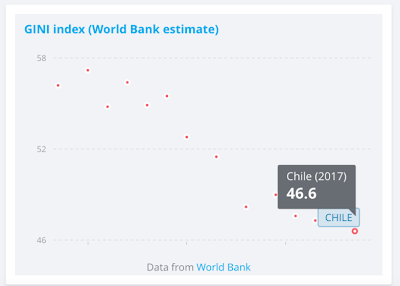
Another phenomenon that both protesters and media appear to ignore is the historic decrease in income inequality that has occurred in the same time frame discussed above. This is illustrated by the country’s GINI coefficient, a statistical measure of the distribution of wealth in a country, where a 0 is completely equal distribution and 1 (100) would be all the wealth residing with one person. In 1990 Chile’s GINI was 57.20 compared to 46.6 in 2017.
 

Whether this reduction in income inequality was the direct result of economic freedom is difficult to determine. More equal distribution can also occur through coercive policies such as high marginal tax rates, yet this damages the country’s overall long-term wealth. Instead, if that money were to be reinvested or saved, capital accumulation would generate positive spillovers for the poorest of citizens. Over time this creates downward pressure on prices as businesses are able to operate with more efficient tools and the population increasingly develops human capital, creating a more productive workforce. While in some cases economic freedom may lower income inequality, in others it may increase it, but that is acceptable as long as everybody (including the bottom 10%) can enjoy the benefits of a wealthier society.

While the GINI coefficient and average wages may indicate that the median conditions are better than neighboring countries, these measurements tell us nothing about those who are worse off. World Bank estimates that Chile’s poorest 10% of the population has 1.9% share of the country's income, higher than all border countries. Even though Chile does not have the largest GDP in the region, the poorest Chileans still have higher incomes than their immediate counterparts.

Country
Total GDP in $USD
Bottom 10% Share of GDP
Bottom 10% Share of GDP  in $USD
10% Of Total Population
Average Individual Share of Income For Poorest 10% Of Country
Chile
$277,746,000,000.00
1.90%
$5,277,174,000.00
1,847,043.90
$2,857.09
Argentina
$624,696,000,000.00
1.80%
$11,244,528,000.00
4,404,481.10
$2,552.97
Peru
$211,007,000,000.00
1.20%
$3,587,119,000.00
3,144,429.70
$1,140.79
Bolivia
$37,509,000,000.00
1.7%
$450,108,000.00
1,119,285.40
$402.14

*All Figures from 2017

https://data.worldbank.org/indicator/SI.DST.FRST.10?locations=CL-AR-PE-BO&name_desc=false
https://data.worldbank.org/?locations=CL-AR-PE-BO


In short, protesters have every right to bring to light atrocities committed by their government. It is wrong, however, to assume that the same government, or any other mix of bureaucrats, can deliver financial freedom through interventionist policy and coercive action. Instead, the focus should be on empowering individuals to pursue their own ends through free exercise in the market. Admittedly this could distort the distribution of income but at the expense of no individual --voluntary exchange is not a zero-sum game. Granting consumers the power to reward the producers who best serve their interests allows for concentration of income, but everybody, regardless of their share of that income, is made better off.
"Only because inequality of wealth is possible in our social order, only because it stimulates everyone to produce as much as he can and at the lowest cost, does mankind today have at its disposal the total annual wealth now available for consumption. Were this incentive to be destroyed, productivity would be so greatly reduced that the portion that an equal distribution would allot to each individual would be far less than what even the poorest receives today.”- Ludwig von Mises, Liberalism, 1927.

Jacob C. Maichel is a Graduate Assistant at the Gwartney Institute and an MBA student at Ottawa University

Bergh, Andreas, and Therese Nilsson. 2010. “Do Liberations and Globalization Increase Income Inequality?” European Journal of Political Economy, 26(4):488-505.

Friday, November 15, 2019

Why Capital Accumulation is Key to Raising Wages

By Jacob C. Maichel
"There are no other means by which the general standard of living can be raised other than by accelerating the increase of capital as compared with population" -Ludwig von Mises

It is clear that arbitrary minimum wage laws are not only ineffective, but actually detrimental to real wage growth. So what type of action results in increasing wages in the United States, or any country for that matter? The only way to raise real wages is to increase the per head quota of capital invested by increasing capital accumulation. To accomplish this it is first important to understand what is meant by capital accumulation.

Capital accumulation, as explained by Austrian Economist Ludwig von Mises, is wealth that is created and owned by businesses and individuals. This wealth is both saved and reinvested to create further profit. The capital which is accumulated is encompassed in everything that businesses utilize from tools to finished goods, and everything in between. Both individuals and businesses create further profit by loaning out excess wealth (either through direct investment or holding money in traditional savings accounts). It is important to note this accumulation can only occur when more wealth is created and saved than that which is consumed.

With the understanding of how capital accumulation works we can now examine how it will increase real wages. It is critical in this discussion to break down the commonly held belief that wealth and the creation of wealth is zero-sum. It is fallacious to assume the wealthy getting richer makes the poor worse off. Instead this wealth creation makes everybody better off! The standard of living in the United Sates is higher than anywhere else in the world not because our politicians are superior to their foreign counterparts, but instead because of the high per head quota of capital that is invested. This high level of investment has allowed businesses to use the most efficient tools available through capital investments, and this is why United States workers are so productive. Other countries do not lack the intelligence to grow but suffer from inadequate capital needed to drive higher efficiencies which lead to increasing production yields. As the accumulation of capital becomes larger wages will raise as businesses compete for the most skilled workers. Only through the free market can wages increase for everyone, rather than the lucky few who benefit from minimum wage laws. 

The best way for government to encourage capital accumulation is to leave the market alone. Manipulating interest rates and the money supply through the federal funds rate or monetary policy sends the wrong signals to businesses. As the interest rate artificially drops and encourages borrowing individuals will save less and business will take on projects they would have not pursued otherwise. These malinvestments, as Mises calls them, are the direct cause of government intervention and detrimental to the accumulation of capital. Examples of malinvestment are present all over the world, from the United States housing bubble to unfinished sky scrapers such as the Nakheel Tower in Dubai. 

Another strong way to encourage capital accumulation is through lowering tax rates, particularly for corporations and wealthy individuals. Although this may be counter-intuitive for some who think that it is the governments role to redistribute excess wealth to help the common man, this is not the case. In Planning for Freedom: Let the Market System Work Mises states the following:
"United States were in the last decades directed toward confiscating ever-increasing portions of the wealth and income of the higher brackets. The greater part of the funds thus collected would have been employed by the tax-payers for saving and additional capital accumulation. Their investment would have increased productivity per man-hour and would in this way have provided more goods for consumption. It would have raised the average standard of living of common man. If the government spends them for current expenditure, they are dissipated and capital accumulation is concomitantly slowed down."  
The tax payers or businesses are able to save and invest more if they are taxed less, or not at all. Although this does make them more wealthy, it does not make the common man more poor. Instead from a material perspective everybody prospers. By allowing wealth accumulation resources are enabled to flow into their most efficient use, dictated by consumer demand, instead of bureaucrats deciding how money is transferred. The following graphic from Tax Foundation is a perfect illustration of Mises' argument, lower taxes results in increased production and wages.
 Anti-growth policy and propaganda has been incredibly strong in attempting to destroy Austrian Economic ideals, particularly in the recent years. We are continually told that wealth is a bad thing when clearly that is not the case. The most effective way to increase production and the standard of living to promote wealth creation and saving by leaving the free market to it's own devices, unfettered by interventionist policy. A laissez-faire approach does not strictly favor the wealthy capitalist, but rather the interests of the common man.

Jacob C. Maichel is a Graduate Assistant at the Gwartney Institute and an MBA student at Ottawa University